02 · Industry watch & critical analysis
AI in marketing, fall 2026: what really changed (and what you can ignore)

Luca Sole
·
In just eight days at the end of September, four new AI models came out: Claude Opus 5.5, GPT-6 Sol, GPT-6 Luna and Gemini 4 Argon. If you feel like you can’t keep up anymore… you’re not alone.
The good news is that you don’t need to follow everything. Among this fall’s AI marketing news, only a few items really change your work: how Google serves your ads, how AI assistants cite (or don’t cite) your brand, and what the tools cost. The rest can wait.
In this roundup, we’ve done the sorting for you: what’s changing, what to do about it, and what you can ignore without regret.
The essentials in 30 seconds
Models: new releases often cost less for equal or better results. No need to switch tools with every launch.
Google Ads: AI Max for Search replaces the old settings. Dynamic Search Ads switch over in February 2027.
Advertising in ChatGPT: it’s already available in Canada, and local businesses can buy it themselves.
AI visibility: ranking well in Google doesn’t guarantee being cited by ChatGPT.
In Quebec: BDC’s LIFT program ($500M) is the main funding lever since the CDAP closed.
1. Models: lots of announcements, only one trend that matters
September felt like a race. OpenAI kicked things off on September 3 with GPT-6 Astra, its flagship model. On September 22, the very same day, Anthropic launched Claude Opus 5.5 and OpenAI answered with GPT-6 Sol and GPT-6 Luna. Google closed out the month on September 30 with Gemini 4 Argon.
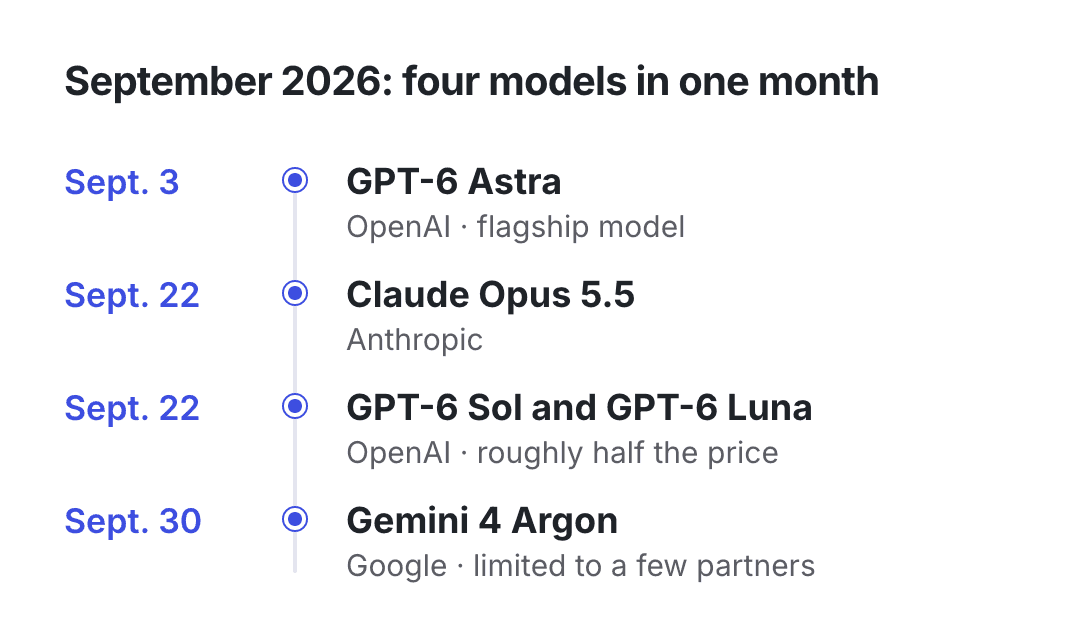
For marketing professionals, the real news isn’t in the names… it’s in the prices. Sol and Luna cost roughly half as much as their predecessors. Luna is aimed squarely at repetitive, high-volume tasks: summarizing documents, extracting information, answering simple questions. In other words, a good share of everyday marketing work.
And Gemini 4 Argon, billed as Google’s most powerful model? For now, it’s reserved for a small group of cybersecurity partners. You can’t use it, and that’s fine.
Should you switch tools with every launch?
No. The gap between the top models now shows up on highly specialized tasks (programming, scientific research), rarely on writing a newsletter or analyzing a campaign.
What makes the difference is the quality of your instructions, your examples and your method. A team that masters one tool gets better results than a team that switches every month. The right reflex: stick with your main tool, and take advantage of price drops when they reach your subscription.
2. Google Ads: AI Max for Search becomes the norm
If you run Search Network campaigns, there’s a good chance AI Max is already active in your account… without you asking for it. Since September, Google has automatically switched over campaigns that used automatically created assets or campaign-level broad match. Dynamic Search Ads (DSA) have a reprieve: their automatic migration will happen in February 2027.
Google highlights an average 7% gain in conversions. That figure deserves a careful read: it compares AI Max with all its features to AI Max with a single feature, not to a classic campaign. And on the ground, several agencies are seeing cost-per-click increases, up to 15% in a year for some clients. The gain may well be real, but it has to show up in your numbers, not Google’s.
What actually changes in your campaigns
Your keywords become signals rather than rules. Google also relies on your pages and ads to find searches you hadn’t anticipated, rewrites some headlines, and can send users to a different page on your site than the one you chose.
In exchange, you get new controls: brands to target or exclude, text guidelines, and location controls.
Three things to do before February 2027
Take inventory. Identify the campaigns that have already switched over and those still using DSA.
Back up your exclusions. Export your negative keywords and URL exclusions: they’re the most fragile settings during an automatic migration.
Test on a single campaign. Migrate it yourself with Google’s tool, and track two numbers for a month: conversions and cost per click.
What about advertising in ChatGPT?
Good news for Quebec: ChatGPT has been showing ads in Canada since March, and local businesses can buy their own placements. The ads target users on the Free and Go plans, and targeting is based on the context of the conversation, not on keywords.
For an SMB, the right reflex isn’t to move your budget, but to keep an eye on this new channel… and to test small if your industry lends itself to it.
3. AI visibility: you can now measure whether ChatGPT cites your brand
For twenty years, the question was simple: “Do I rank well in Google?” That’s no longer enough. When a customer asks ChatGPT, Gemini or Perplexity “which agency should I choose in Montreal?” or “what software should I use to manage my bookings?”, they get a ready-made answer with a handful of brands cited. The others don’t exist.
This is what’s called AI visibility, or GEO (for Generative Engine Optimization). And this fall, it’s becoming measurable: a new category of tools tracks, question by question, which brands AI assistants cite and how often.
Engines don’t all behave the same way
The first lesson from these measurements: each assistant draws on its sources in its own way. An Ahrefs study covering 15,000 queries shows that, on average, only 12% of the links cited by ChatGPT, Gemini and Copilot appear in Google’s top 10 for the same question. Perplexity is the exception: nearly one citation in three points to a top-10 page.
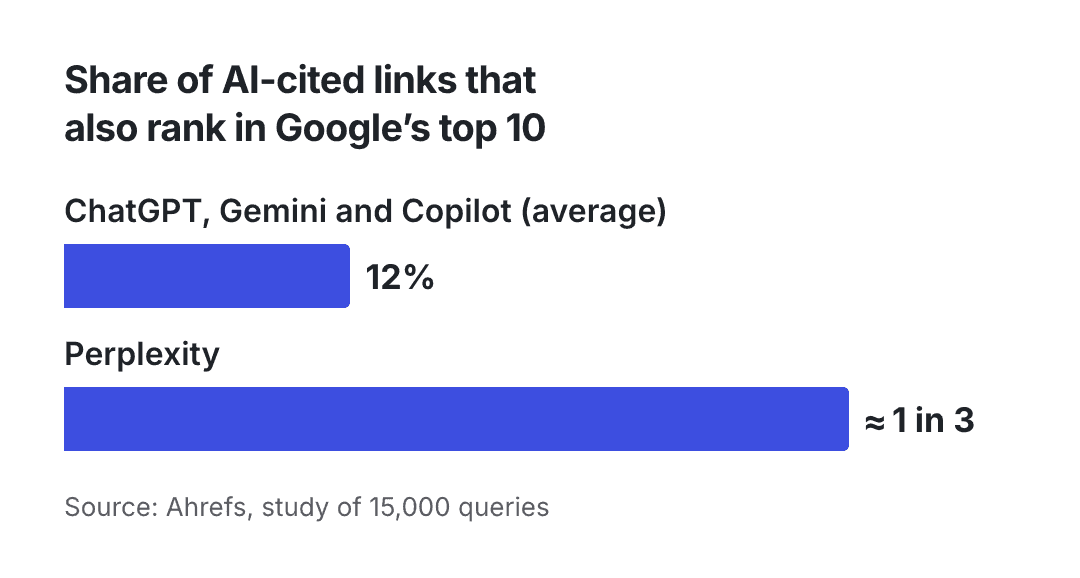
Put simply, good SEO helps on Perplexity, much less on ChatGPT. ChatGPT relies more on third-party sources: directories, press articles, review sites, Wikipedia. Being mentioned somewhere other than your own website matters more than before.
The technical mistake that makes pages invisible to AI
Many AI crawlers read a page without running its JavaScript. The result: if your menu, internal links or service descriptions only appear after a script loads, these crawlers simply don’t see them.
The test is easy: turn off JavaScript in your browser and reload your homepage. If your important links and text disappear, talk to whoever manages your website.
Where to start?
No need to buy a tool tomorrow. Start by getting your bearings: the Réflexe IA Diagnostic assesses, for free and in about 3 minutes, where your team stands, including on AI visibility. Then try the manual test suggested below, in this month’s reflex.
4. Commerce and social media: shopping agents are arriving
On September 8, Meta launched Muse, a personal AI agent that can search, compare… and buy on the user’s behalf, with their approval. Shopify followed the same day: products from eligible stores are shared with Muse by default. On September 21, the two companies announced direct checkout with Shop Pay. Amazon, for its part, blocked the agent.
On September 29, Meta also opened Muse to small businesses. The agent can connect to Instagram insights, Facebook Pages and Meta ad accounts to help manage day-to-day marketing.
Should you deal with it now? For most Quebec SMBs, not yet: the launch is aimed first at the United States. One exception, though… if you sell on Shopify, your products may already be visible to these agents. Take five minutes to check your settings and the quality of your product listings: an agent reads your descriptions, not your nice layout.
5. What about Quebec?
According to BDC, only 30% of Canadian SMBs were using AI in 2025. And that figure probably underestimates reality: as early as 2024, BDC found that 27% of business owners were using AI tools without knowing it. That’s “invisible AI,” the kind hidden in your accounting software, your newsletter tool or your advertising platform.
On the funding side, one door has closed: the Canada Digital Adoption Program (CDAP) hasn’t accepted applications since 2024. Two options remain on the table:
LIFT, from BDC: a $500M envelope launched in April 2026 that matches eligible SMBs with AI consultants and offers loans from $25,000 to $5M. The AI stream targets businesses with at least $1M in revenue.
The Regional Artificial Intelligence Initiative (CED): an interest-free repayable contribution covering up to 50% of costs for Quebec SMBs adopting AI. It runs until March 2031.
For a fuller picture of AI adoption in Quebec, the figures from the Institut de la statistique du Québec are presented in our first article.
6. What you can ignore without regret
Following AI doesn’t mean following everything. Here’s what you can let slide this fall, at no risk to your marketing:
The benchmark race. Every launch comes with its chart where the new model beats all the others. These tests measure advanced math or programming, rarely the quality of a LinkedIn post.
Models reserved for a few partners. Gemini 4 Argon is making headlines, but no one on your team can use it today.
Giant open-source models. Fascinating for developers, useless for an SMB without a technical team to install them.
You’re allowed not to read everything… it’s even a skill.
7. This month’s reflex: test your brand in two AIs
Ten minutes is enough to find out whether AI assistants know you.
Ask a customer’s question. Pick the one a customer would ask before finding you, for example: “What are the best [your service] companies in [your city]?”
Compare two assistants. Ask ChatGPT and Gemini the exact same question, and note the brands they cite.
Compare with Google. Run the same search in Google. Are you cited everywhere, nowhere, or in just one place?
Write down your results and repeat the test in three months. It’s your first AI visibility indicator, and it costs you nothing.
Frequently asked questions
What are the main AI marketing developments in 2026?
This fall, three changes matter: AI Max for Search is becoming the norm in Google Ads, advertising is arriving in ChatGPT (already available in Canada), and you can now measure whether AI assistants cite a brand. The new models, for their part, mostly make AI cheaper.
What is AI Max for Search?
It’s a set of AI features added to Google Search Network campaigns. It expands targeted searches beyond your keywords, adapts ad copy and can choose the landing page. It replaces Dynamic Search Ads, whose automatic migration will happen in February 2027.
What is GEO?
GEO (Generative Engine Optimization) covers the practices that help a brand get cited in the answers of AI assistants such as ChatGPT, Gemini or Perplexity. It’s a cousin of SEO, but the rules differ from one assistant to another.
Should you switch AI tools with every new model?
No. For everyday marketing tasks, the gap between the top models is small. The quality of your instructions and your method matters more than the name of the model.
Sources
Google, We’re upgrading Dynamic Search Ads to AI Max (April 2026, updated with the postponement to February 2027)
Marketing Dive, Google brings AI Max for Search out of beta
Digiday via Digimarcon, CPC pain is real: one year on, Google’s AI Max
The Prompt Insider, Google auto-migrates Search campaigns to AI Max
Digiday, OpenAI’s ads business hits Europe at the six month mark
The Next Web, OpenAI is bringing ChatGPT ads to 31 European countries
Versely, GPT-6 Sol and Luna: what launched and what it costs
TechCrunch, Google releases Gemini 4 Argon
TechCrunch, Meta is expanding its AI agent Muse to small businesses
Forbes, Meta’s Muse AI agent tests who controls digital distribution
BDC, BDC lance LIFT pour aider les PME à passer de l’intention à l’action en IA (April 24, 2026, in French)
BDC, 27 % des entreprises canadiennes ignorent qu’elles utilisent l’IA (September 11, 2024, in French)
Les Affaires, BDC : programme de 500 M$ pour favoriser l’adoption de l’IA (in French)
Canada Economic Development, Initiative régionale en matière d’intelligence artificielle : investissements au Québec (July 15, 2026, in French)
Luca Sole
Digital marketing lecturer at ESG UQAM and executive director of Charity Rocket.
Read next
Le Réflexe IA: why SMB leaders don't need more tools →
Free diagnostic · 3 min
Where does your team stand with AI? Take the Réflexe IA Diagnostic →
Le Réflexe IA comes out once a month with an in-depth topic and a roundup of AI news relevant to small businesses.